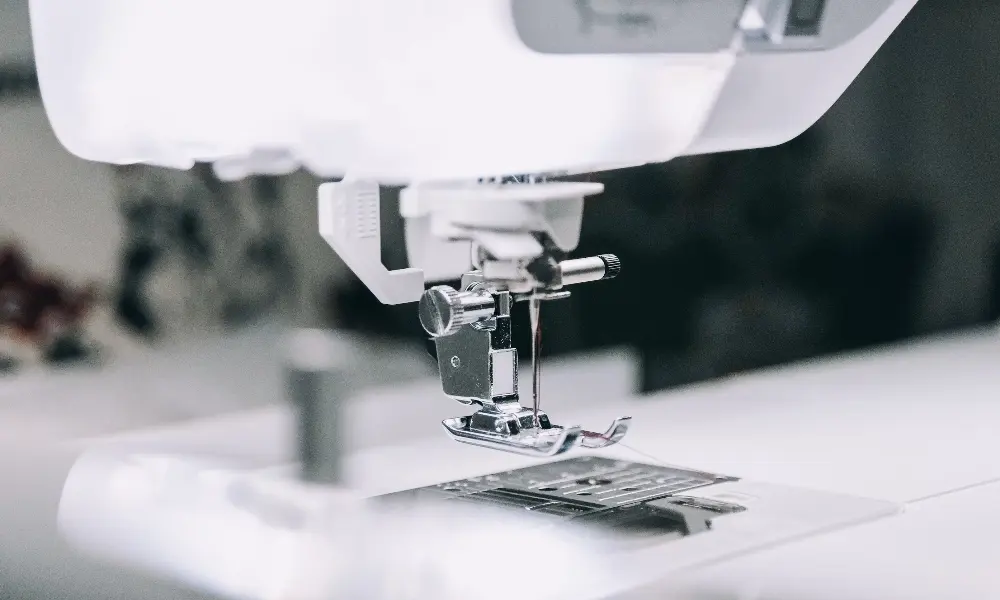
Why Presser Foot Pressure Controls Seam Quality
Presser foot pressure is one of the least visible settings on an industrial sewing machine, but it directly affects three things on every seam: how the fabric is held against the feed dog, how the needle enters the fabric, and how consistently the plies advance as one unit.
When pressure is too high, the foot can mark delicate fabrics, feed teeth can distort or crush the material, and the operator may have to fight the machine when positioning or turning workpieces. The seam can also become pucker-prone because the upper and lower plies are forced together too aggressively before the stitch is formed. When pressure is too low, the fabric can lift or shift, causing skipped stitches, uneven stitch length, ply misalignment, and seam width variation.
In industrial garment produktion, these defects are not cosmetic. They create rework, slow the line, and reduce first-pass quality. The correct pressure setting is therefore part of the machine setup procedure, not just an operator preference. Stitch classes and seam types are classified in ISO 4915 and ISO 4916, and ASTM D6193 connects stitch formation to the material behavior of the sewn seam [1][2][3].
How Adjustable Presser Foot Pressure Works
An adjustable presser foot pressure system lets the line change the downward force applied by the foot. On many industrial lockstitch machines this is done through a spring-loaded dial or knob above the head, normally paired with a visible scale. Some automated machines use pneumatic or electronic control, but the core principle is the same: the nip force can be increased or reduced without changing the foot itself.
Adjustable pressure is useful in factories that run more than one fabric group on the same machine. A light chiffon setting can be changed to a heavier denim setting when the line moves to a new order. The setting is normally matched to the stitch class, seam type, and number of plies in the assembly [1][2].
The main limitation is that adjustability only improves quality when the setting is changed correctly. If operators do not know the baseline for each fabric, the dial becomes another source of variation. For this reason, many factories use a master setting sheet and keep the adjustment as part of the style changeover procedure.
How Fixed Presser Foot Pressure Works
A fixed presser foot pressure system is calibrated at the factory, often with a pre-set spring or a locked pneumatic setting. The operator cannot easily change the downward force, which makes the machine repeatable and stable on a dedicated product line.
Fixed pressure works well when a line produces the same fabric type and similar seam constructions over long runs. For example, a denim hemming station or a lightweight knit overlock station can run a fixed setting without quality loss because the material conditions do not change much between orders.
The trade-off is flexibility. If the same machine must handle both a delicate lining and a heavy multi-layer seam, a fixed setting may be a compromise in one direction: either too much force for the light fabric or too little for the heavy assembly. In those mixed-use cases, the machine specification should either provide an adjustment range or clearly limit the station to a defined fabric group.
Fabric-by-Fabric Pressure Requirements
The best choice between adjustable and fixed pressure depends on the fabric mix that will actually pass through the station. The table below separates common production cases.
| Fabric group | Pressure demand | Better choice | Key control points |
|---|---|---|---|
| Lightweight wovens such as chiffon, georgette, lining | Low pressure to avoid marking and puckering | Adjustable with a light baseline | Use a smooth foot and fine feed dog; avoid excessive foot stroke |
| Knits and stretch fabrics | Low to moderate pressure to avoid stretching plies ahead of the needle | Adjustable or carefully calibrated fixed | Verify the foot does not press wavy edges into the seam |
| Denim and heavy twill | Higher pressure for positive feed, especially at cross-seams | Fixed or adjustable set high | Watch for feed marks and needle deflection |
| Leather and coated fabrics | Moderate pressure plus proper feed assistance | Adjustable with compound feed where possible | Use a roller or Teflon foot to prevent surface damage |
| Multi-layer technical assemblies | High pressure for ply control at seam crossings | Adjustable or fixed with feed upgrade | Confirm the pressure is applied evenly across the full foot width |
| Slippery synthetics such as nylon taffeta | Low to moderate pressure to reduce ply shift | Adjustable | Pair with fine-tooth feed and edge guide |
| Pile and fleece fabrics | Low pressure to avoid crushing the surface | Adjustable with a low setting | Test on a multi-layer sample before bulk |
| Elastic and lingerie components | Low pressure to preserve recovery and avoid distortion | Adjustable | Check seam extension against the approved sample |
For stitch classes that require stretch behavior, the foot should not stretch the material ahead of the needle. This is particularly important on knit and elastic seams covered by stitch and seam classification standards [1][4].
When Adjustable Pressure Pays Off in Production
Adjustable presser foot pressure is not always the safer choice, but it usually pays off when the line has frequent style changes, mixed fabric families, short orders, or a wide range of imported and locally sourced materials.
In those conditions, the machine setup moves from one fabric behavior to another several times per day. A dial-adjustable spring lets the line supervisor return the station to a known baseline without changing springs or calling maintenance. The setting can also be reduced during operator training to make the machine less punishing on fabric positioning errors.
A fixed setting better suits a stable, high-volume line where the machine is purchased for a narrow product range. In that case, fixed pressure removes one adjustment point and helps standardize output across operators and shifts. The economic decision is therefore not “adjustable versus fixed” in isolation; it is whether the station is a general-purpose workhorse or a dedicated production cell [5].
Presser foot pressure is one control among several that determine feed consistency. <Viktiga skillnader mellan sömnad av broderiklippmaskiner> covers how feed systems and machine categories differ across sewing, embroidery, and cutting operations.
Key Machine Features to Specify
When ordering a machine for a specific fabric program, the pressure system should be specified together with the feed system, foot type, and stitch class.
Pressure adjustment mechanism
Ask whether the machine uses a spring dial, a calibrated knob, an air regulator, or an electronic setting. For manual systems, a visible scale makes repeatability much easier. For pneumatic systems, the air supply and regulator must be stable enough to hold the pressure during a full shift.
Foot type and surface
The presser foot design works with the pressure setting. A standard flat foot, roller foot, Teflon foot, or floating foot can change how the force is distributed. On coated and slippery materials, the foot surface matters as much as the pressure value.
Feed system compatibility
Pressure is only one part of the material-advance system. Drop feed, needle feed, compound feed, and puller-assisted feeding have different sensitivity to presser foot force. On heavy or sticky materials, increasing pressure alone is rarely the right solution; a compound feed or walking foot arrangement may be required instead [2].
Setup documentation
A good machine specification includes the recommended pressure baseline for each fabric group. This is a practical operator aid. It should state the fabric type, number of plies, stitch class, seam type, and whether the setting may be changed during production.
Before you issue a machine specification, send the main fabric list, seam class, and expected production volume to sales@tzpioneer.com. A UNIQUE application engineer can help you decide whether a dial-adjustable spring, calibrated fixed setting, or pneumatic pressure control is the safer factory default for the products you actually run.
Specify the Right Presser Foot Pressure for Your Fabric Mix
The correct pressure system is the one that matches your real production mix, not the one with the most features. For a dedicated denim line, a fixed setting may be more stable. For a line that moves among chiffon, jersey, twill, and coated fabrics, adjustability becomes a practical requirement.
Send UNIQUE your fabric samples, target stitch class, seam type, and expected line speed. The technical team will help you select machines that match the pressure system, feed mechanism, and foot configuration to the work you need to produce. Contact sales@tzpioneer.com or +86-18069305333 with a short description of your current fabric handling and seam quality problems.
Frequently Asked Questions
Is adjustable presser foot pressure necessary for a small factory?
It depends on the product range. A small factory running a narrow fabric mix can operate well with fixed pressure. A small factory taking varied contract work usually benefits from adjustable pressure because the same machine must handle different materials on short notice.
What happens if presser foot pressure is too high?
The fabric may be marked or crushed, feed teeth may distort the surface, and the seam can pucker because the plies are held too tightly before stitch formation. On stretch fabrics, excessive pressure can also elongate or wave the material ahead of the needle.
What happens if presser foot pressure is too low?
The foot may not hold the fabric securely against the feed dog, causing skipped stitches, uneven stitch length, ply shift, and inconsistent seam width. At high speed, the material can lift or drift before the needle penetrates.
Can presser foot pressure be changed while the machine is running?
On most manual industrial machines, the setting should be changed with the machine stopped or during setup, not during sewing. Some electronic and pneumatic systems allow programmed changes, but the setting still needs to be verified on a test seam before bulk production.
Which is better for stretch fabrics?
Adjustable pressure is generally more useful because stretch fabrics are sensitive to excess foot force. The goal is enough pressure to feed the fabric without stretching the plies ahead of the needle. A fixed setting can work if the station is dedicated to one knit construction and has been correctly calibrated.
What should I specify when ordering a machine for mixed fabrics?
Specify the fabric groups, number of plies, stitch class, seam type, and whether operators are allowed to adjust pressure. Include the most difficult seam crossing or thickest assembly on the list so the supplier can confirm the pressure range and feed system.
Referenser
[1] ISO 4915:1991, Textiles — Stitch types — Classification and terminology, International Organization for Standardization.
[2] ISO 4916:1991, Textiles — Seam types — Classification and terminology, International Organization for Standardization.
[3] ASTM D6193-16, Standard Practice for Stitches and Seams, ASTM International.
[4] Federal Standard 751A, Stitches, Seams, and Stitchings, U.S. General Services Administration.
[5] Carr, H., & Latham, B. (2000). The Technology of Clothing Manufacture (4th ed.). Blackwell Science.
[6] The Textile Institute. (n.d.). Textile Terms and Definitions. The Textile Institute.
Om du är intresserad, kolla in dessa relaterade artiklar:
Empowering Hanoi Shaping The Future Meetlin är framgångsrikt värd för Vietnam Garment Industry 4 0 Summit
Meetlin Group Conducts Technical Exchange With Zhejiang Qixing Empowering Service Upgrading Of Unique Series Equipment In The Market