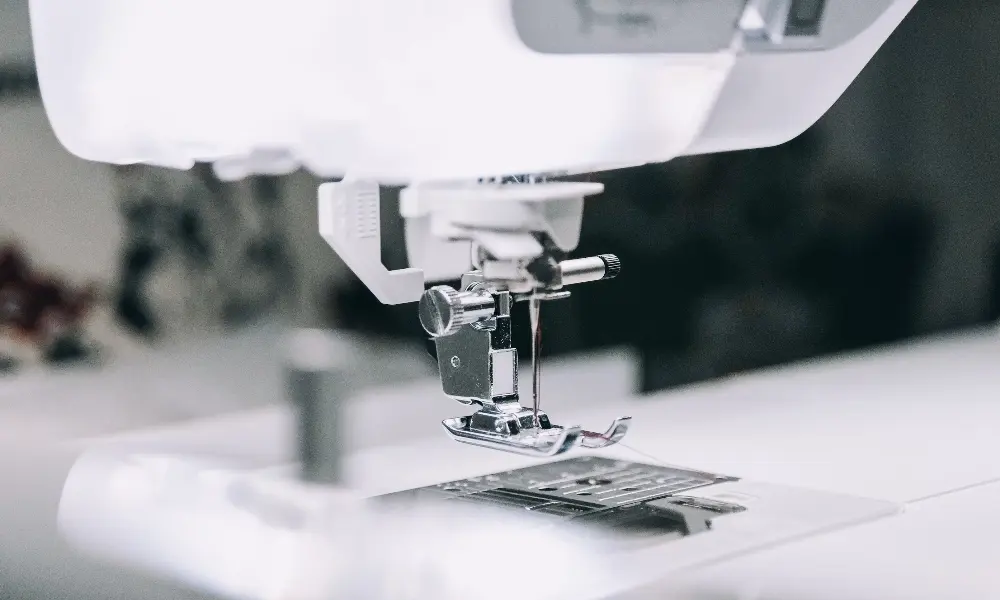
Luggage and suitcase 제품ion is not a heavier version of garment sewing. The material stack changes quickly from a single fabric ply to face fabric, foam, board, webbing, and lining at the same seam crossing. That type of work punishes a light industrial machine. If you choose the wrong feed system or bed shape, you will see skipped stitches, needle deflection, poor seam alignment, and high rework. This guide explains how to specify luggage and suitcase 미싱s by operation, so the line stays balanced and the seams hold.
If you are currently quoting a new luggage production line, email sales@tzpioneer.com with your panel thickness, shell type, handle design, and daily output target for a machine list matched to your material.
Why Luggage and Suitcase Sewing Machines Are a Separate Class
Soft luggage and hybrid suitcases combine some of the most difficult sewing conditions in industrial work. A single edge may contain:
- Heavy nylon or polyester face fabric with a PVC or PU backing
- Several millimeters of PE or EVA board for shape retention
- Open-cell or closed-cell foam
- Polyester lining
- Multiple layers of webbing, binding tape, and piping cord
The seam must stay aligned while the operator lifts and rotates the workpiece. Standard garment flatbeds do not give enough clearance under the presser foot, and their feed systems lose control when thickness changes. This is why luggage lines are built around compound-feed machines, cylinder or postbed configurations, and heavy-duty bar tackers.
Core Machine Types for Luggage and Suitcase Operations
| Operation | Best machine type | Why it fits |
|---|---|---|
| Panel and main seams | Flatbed compound-feed or triple-feed lockstitch | Keeps face fabric, foam, and board aligned on long runs |
| Curved shell edge binding and piping | Cylinder bed compound-feed lockstitch | The narrow bed reaches into corners for gussets and curved shell edges |
| Handle, D-ring, base, and 3D trim | Postbed lockstitch | The raised postbed lets the operator reach inside shaped suitcase parts |
| Webbing strap ends and handle anchors | Heavy-duty bar tacking machine | Dense bar tacks hold under repeated lifting load |
| Zipper chain and edge tape insertion | Binding attachment or guided folder on a cylinder bed or special function machine | Controls tape feed while stitching around the shell |
Among these, the cylinder bed lockstitch sewing machine is usually the backbone for curved shell work, while the postbed lockstitch sewing machine supports handles and shaped components. A dedicated bar tacking machine handles high-load strap anchors. For smaller shops, bag sewing machines can be specified as a package against a sample swatch.
Matching Machine Specifications to Luggage Materials
Before choosing a model, check five machine features:
- Feed system: compound feed or triple feed is preferred. It combines bottom feed, needle feed, and an alternating presser foot, so plies stay aligned when thickness rises.
- Foot lift and clearance: luggage seams require more foot lift than garment seams, especially at panel-to-gusset crossings.
- Hook and thread capacity: the machine must run bonded heavy thread without jamming in the hook path.
- Stitch length range: structural seams in coated luggage fabric usually need a longer stitch length than garment seams, often around 3–4 mm, to avoid excessive needle perforation.
- Low-speed torque: a servo or direct-drive motor with good low-speed control helps the operator steer around curved shell edges without losing stitch quality.
A practical material match looks like this:
| Material stack | Recommended machine class | Needle and thread notes |
|---|---|---|
| Ballistic nylon, foam, and board | Cylinder bed compound-feed lockstitch | Heavy-duty needle, commonly 110/18 to 140/22, with bonded polyester or nylon thread |
| PVC-backed polyester and webbing | Flatbed or cylinder bed compound feed | Moderate to heavy needle; longer stitch length to reduce coating damage |
| Bonded leather or faux leather handles | Postbed lockstitch | Edge folding and gluing before stitching improves seam control |
| Multi-layer webbing strap ends | Heavy-duty bar tacker | Heavy bonded thread with dense tack pattern |
| Polyester lining and internal dividers | Medium or heavy single-needle lockstitch | Lighter thread than shell seams |
Mid-spec check: If your sample skips only at the panel-to-gusset crossing, do not buy a faster machine to fix it. Record the material stack, thread size, and current foot lift, and send a short video to sales@tzpioneer.com. The usual cause is a feed clearance or needle deflection issue, not a speed problem.
Stitch Type, Thread, and Seam Quality
Most structural luggage seams use lockstitch, classified as stitch class 301 under ISO 4915 [1]. Lockstitch is preferred because it is secure from both sides and less likely to unravel when a bag is loaded and handled roughly. Seam construction should follow ISO 4916 principles, especially where panels, gussets, piping, and binding meet [2].
Thread choice matters more than high machine speed. Bonded nylon and bonded polyester are common because they resist abrasion and stay compact under tension. The thread must pair with the needle system and hook size. If the thread is too heavy for the hook, loop formation becomes unstable and the seam looks tight on the surface but weak inside.
For coated fabrics, a round point usually penetrates cleanly without cutting the coating. For leather trim, a leather point often gives a cleaner hole and better seam appearance. Operator training should focus on stitch balance, because the textbook balanced stitch is what keeps a luggage seam from grinning open along the top edge.
Building a Balanced Luggage Production Line
A balanced line follows the sequence of the part:
- Cutting and edge preparation: cut panels, fold edges, and glue trim or leather before stitching.
- Flatbed structural sewing: assemble side panels, dividers, and lining sections.
- Cylinder bed binding: attach piping and edge binding around curved shell openings.
- Postbed assembly: attach handles, D-rings, base components, and shaped accessories.
- Bar tacking: reinforce strap ends, handle anchors, and high-load points.
- Inspection: check seam tension, topstitch alignment, zipper placement, and heavy-point security.
Do not buy multiple high-speed flatbeds simply because they are cheap. Luggage lines usually fail at the curved, thick, and three-dimensional operations. A slower postbed or cylinder bed that holds the seam correctly is worth more than a fast flatbed that produces rework.
Factory layout can be improved by sourcing cutting, sewing, and finishing equipment through one supplier. <원스톱 재봉 장비 조달 플랫폼> covers how a full-range supplier simplifies technical support and spare parts.
Buying Checklist for Luggage and Suitcase Sewing Machines
Use this checklist before confirming a machine list:
- Maximum material stack thickness, including crossed seams
- Required bed shape: flatbed, cylinder bed, or postbed
- Feed system: compound feed rather than drop feed for structural shell seams
- Maximum stitch length and presser foot lift
- Hook capacity for the planned bonded thread size
- Needle system and largest needle size the machine accepts
- Availability of hook, feed dog, presser feet, and needle plate spares
- Motor type and low-speed torque control
- Operator table clearance for rotating large panels
- Machine guarding and safety compliance for industrial sewing equipment [3]
Get a Balanced Luggage Sewing Quote
Machine count is not the first metric. The first metric is whether each head is specified for a real material stack. I’m William from Taizhou Unique Machine Technology Co., Ltd., and my team works from your panel thickness, shell type, handle design, and daily target before recommending equipment. Send sample drawings or material swatches to sales@tzpioneer.com or call +86-18069305333, and we will return a line list covering cylinder, postbed, flatbed, bartack, and finishing equipment in one package.
Frequently Asked Questions About Luggage and Suitcase Sewing Machines
What is the best sewing machine for luggage production?
There is no single best machine. The core for soft luggage is usually a cylinder bed compound-feed lockstitch. A complete line also needs a heavy-duty flatbed, a postbed, and a bar tacker.
Can a standard garment 박음질 기계 sew suitcase panels?
A standard drop-feed lockstitch can sew linings and labels, but it struggles with PVC, foam, and board stacks. It often skips stitches and loses alignment on structural seams.
Do I need a cylinder bed or a postbed machine?
If budget forces a choice, start with the cylinder bed machine for shell curves and binding. Add a postbed later for handle attachment, D-rings, and shaped base work.
What feed system matters most for luggage?
Compound feed or triple feed matters most. It combines bottom feed, needle feed, and alternating presser foot movement, which is more effective than drop feed on thick multi-ply sections.
What thread and needle combination works in heavy luggage?
Use bonded polyester or bonded nylon with a heavy-duty needle size matched to the stack. Many luggage seams pair heavy bonded thread with 110/18 to 140/22 needles, but always verify against a sewn sample.
Should I check machine guarding and safety?
Yes. Look for integrated finger guards, belt covers, eye protection, and compliance with industrial sewing machine safety requirements [3].
Can one supplier provide the whole luggage line?
Yes. A full-range supplier can combine cutting, flatbed, cylinder bed, postbed, bartack, and finishing equipment, which simplifies spare parts and service responsibility.
References
[1] ISO 4915:1991, Textiles — Stitch types — Classification and terminology, International Organization for Standardization.
[2] ISO 4916:1991, Textiles — Seam types — Classification and terminology, International Organization for Standardization.
[3] ISO 10821:2005, Industrial sewing machines — Safety requirements for sewing machines, units and systems, International Organization for Standardization.
관심이 있다면 다음 관련 기사를 확인하세요.
Unique Debuts At Gtb Expo Empowering Bangladeshs Garment Industry Upgrade With Customized Automated Solutions
Unique Shines At Itcpe Vietnam Texprint 2025 Attracting Crowds And Media Spotlight
Meetlin Group Conducts Technical Exchange With Zhejiang Qixing Empowering Service Upgrading Of Unique Series Equipment In The Market
Empowering Hanoi Shaping The Future Meetlin Successfully Hosts Vietnam Garment Industry 4 0 Summit