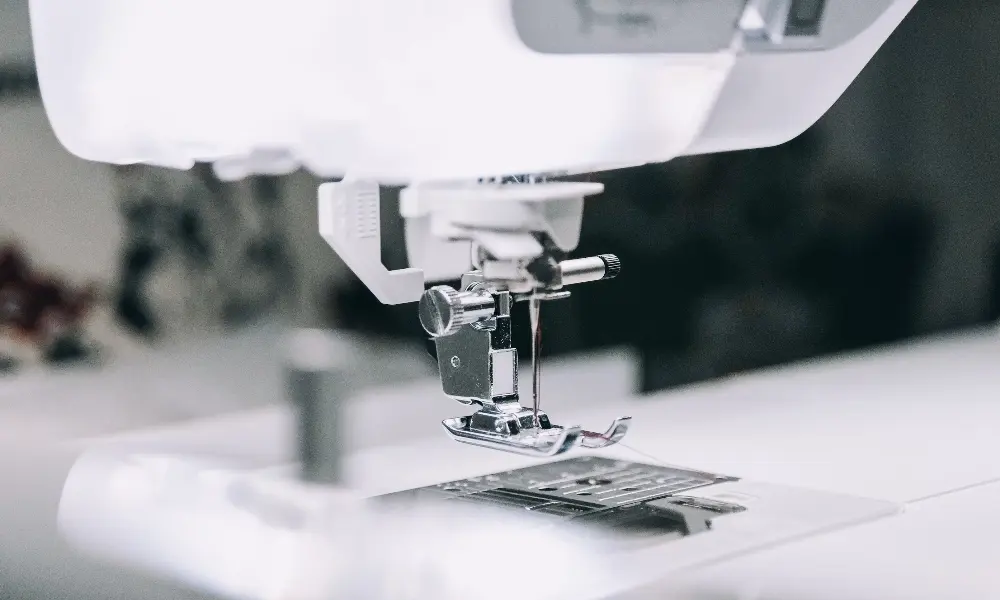
Finger guards and anti-finger-injury devices are part of the machine specification, not a later add-on after an incident. On a garment floor, the operator’s left hand typically controls fabric close to the presser foot while the right hand starts and stops the machine. At that close working distance, the needle bar, take-up lever, drive belt, and feed mechanism create several different contact risks. A finger guard only works when it matches the machine class, the operation, and the way an operator actually moves material through the stitch.
Guard selection starts with machine class and drive type. <Key Differences Between Sewing Embroidery Cutting Machines> covers how sewing, embroidery, and cutting machines create different guarding and workstation requirements.
Where Finger Injuries Start on a Macchina da cucire
Most finger injuries on industrial sewing machines happen at three distinct points:
- Needle entry area. The gap between the needle bar, presser foot, and needle plate is where fingers are closest to the needle stroke. If fabric pulls or slips, the operator’s finger can enter the strike path.
- Take-up lever and thread path. On high-speed lockstitch machines, the take-up lever moves in a short, fast stroke above the needle and below the machine head. It is a pinch and strike point that is easy to overlook.
- Belt, pulley, and motor drive. Clutch-motor and belt-driven machines have rotating parts that remain a contact hazard unless the covers are present and secured.
The risk is not limited to the needle point. ISO 10821 treats an industrial sewing machine as an integrated system, so guarding has to cover the needle, thread-handling area, and power-transmission parts together [1].
Key Types of Finger Guards and Anti-Finger-Injury Devices
The correct device depends on which hazard zone the operator can reach and how much visibility the operation requires. The following table summarizes the main guard types found in garment sewing workstations:
| Guard or device | Typical application | What it does |
|---|---|---|
| Fixed needle guard | Lockstitch and overlock machines | Provides a rigid barrier in front of the needle entry path while leaving the thread line visible. |
| Adjustable needle guard | Machines with different needle positions or long-stroke needle bars | Can be repositioned as needle bar timing or needle position changes. |
| Transparent polycarbonate shield | High-speed close-work operations | Blocks finger entry while preserving visibility of the presser foot and needle area. |
| Belt and pulley cover | Clutch-motor and belt-drive machines | Encloses rotating drive components that can catch fingers or loose clothing. |
| Two-hand or safety start control | Automatic template and pattern stations | Requires the operator’s hands to be outside the moving work area before the cycle starts. |
| Light curtain or zone sensor | Automatic pocket setters, template machines, and special pattern machines | Stops or prevents machine movement when the hand enters the guarded area. |
Lockstitch machines benefit most from a fixed or adjustable needle guard plus a secure belt cover. Overlock machines add trimming blades and higher-speed loopers, so the guard must cover the needle area without obstructing the differential feed controls. Template machines shift the risk from the needle alone to the moving template and clamp, which is why sensor-based safeguarding is more common there.
If a guard cannot be fitted without blocking the operator’s normal view, the machine head, needle bar, and drive combination is probably mismatched. A guard that gets removed for every thread change does not protect anyone.
For a line-specific guard list, send the machine class and operation to sales@tzpioneer.com. The guard set can be confirmed with the machine head before shipment.
For mixed floors that include sewing, embroidery, and cutting equipment, guarding is part of the same specification conversation. <Your One Stop Sewing Equipment Procurement Platform> covers how machine specifications and safety options can be handled in one procurement process.
Standards That Shape Sewing Machine Guarding
Four references matter in most garment-export and factory-safety discussions:
- OSHA 29 CFR 1910.212 requires one or more machine-guarding methods to protect operators from hazards created by point of operation, ingoing nip points, rotating parts, and flying chips or sparks [2].
- ISO 10821 specifically addresses industrial sewing machine safety and covers the needle, thread-handling area, and transmission hazards [1].
- EN ISO 13857 defines safety distances and opening dimensions intended to prevent body parts, including fingers, from reaching a hazard [3].
- Directive 2006/42/EC sets the machinery safety framework for the EU market, including risk assessment, protective measures, and CE marking [4].
The standard to apply depends on the machine’s destination. A factory operating in the United States should meet OSHA requirements; a machine placed on the EU market is normally assessed against the Machinery Directive and its harmonized standards. ISO 10821 is often used by machine builders as a safety design reference regardless of market because it addresses sewing-specific hazards more directly than a general machinery standard.
Matching Guards to Machine Class and Operation
On a single-needle lockstitch line, the main concern is the needle entry zone and the belt drive. The guard should be fixed rigidly, but the operator still needs a clear view of the needle for close-edge and corner work.
On overlock and interlock machines, the cutting blade, loopers, and high feed rate create a wider hazard zone. Guards must cover the blade area and the needle path without limiting the differential feed adjustment, which is precisely the control an operator may need to reach during changeovers.
On multi-needle and specialized operations, multiple needle paths and larger workpieces create a more demanding guarding geometry. Multi needle machines need guards that protect the full needle field but do not hide the stitch formation. For special function machines such as postbed, cylinder bed, or shoe-and-bag machines, guarding is normally integrated into the workstation because a universal guard cannot follow the three-dimensional material path.
When specifying guards for a new line, prepare these details before asking for a machine list:
- Machine bed type: flatbed, cylinder bed, or postbed.
- Needle system and stitch class.
- Motor and drive type: clutch motor, servo motor, or direct-drive.
- Destination market and the safety rule that applies.
- Whether the operation requires close finger work near the presser foot.
Sending this information early prevents a situation where the machine ships with the wrong needle guard and the factory must remove it to run production.
Retrofitting Older Machines Without Creating a New Hazard
Many older flatbed lockstitch machines can accept a bracket-mounted needle guard and a replacement belt cover. The retrofit is practical when the guard does not interfere with normal material feeding, presser foot lift, thread take-up, or the bobbin access area.
When installing or updating a finger guard, check the following:
- The guard bracket stays aligned with the needle bar through the full stroke.
- The open side of the guard does not invite the operator to insert fingers from another angle.
- The material path remains smooth at the needle plate and presser foot.
- Cracked or scratched transparent shields are replaced, not polished and reused.
- Guard fasteners are checked during the same service interval as the needle and feed dog.
A guard is part of the machine’s operating condition, not a temporary accessory. Maintenance should treat missing, loose, or damaged guards with the same priority as a broken needle bar or damaged feed dog.
Guard-Safe Machine Specification
Finger guarding should appear in the same purchase document as the machine head, motor, and table. If you are building a new line, auditing an older floor, or adding automated stations, put the guard requirement into the specification before production starts.
Send the machine list, bed type, destination standard, and operation details to sales@tzpioneer.com or call +86-18069305333. The technical team can check which guard options match the machine class and confirm the correct configuration before the equipment ships.
Frequently Asked Questions
Do all sewing machines need finger guards?
OSHA’s general machine-guarding rule applies when operators can reach a hazard at the point of operation or in the power-transmission system, and ISO 10821 expects industrial sewing machine hazards to be addressed by guarding [1][2]. In practice, an unguarded high-speed lockstitch or overlock machine does not meet that protection level.
Can an old sewing machine be retrofitted with a needle guard?
Many older flatbed models can be retrofitted, but the bracket, needle bar clearance, presser foot stroke, and material path must be checked first. It is a machine-specific installation, not a universal part.
Which standard should I follow: OSHA, CE, or ISO?
OSHA applies to operating conditions in the United States. The Machinery Directive and harmonized standards apply to machines placed on the EU market. ISO 10821 is a widely used sewing-machine safety design reference [1][2][4]. The destination and operating location determine the main compliance path.
Do finger guards slow down sewing?
A poorly designed guard slows operation by blocking visibility or material flow. A properly selected guard keeps the work area visible, allows normal thread access, and reduces the need for unsafe workarounds.
What should I include in a guarding inquiry?
Include the machine model, bed type, needle system, motor or drive type, destination compliance requirement, and whether the operation requires close finger work near the needle.
References
- ISO 10821:2005, Industrial sewing machines — Safety requirements for sewing machines, units and systems, International Organization for Standardization, Geneva, Switzerland, 2005.
- Occupational Safety and Health Administration, 29 CFR 1910.212 — General requirements for all machines, U.S. Department of Labor, Washington, DC, USA.
- EN ISO 13857:2019, Safety of machinery — Safety distances to prevent hazard zones being reached by upper and lower limbs, European Committee for Standardization, Brussels, Belgium, 2019.
- European Parliament and Council, Directive 2006/42/EC of 17 May 2006 on machinery, Official Journal of the European Union, 2006.
If you’re interested, check out these related articles:
Joining Hands For Progress Empowering The Future Dubais Technical Team Completes Technical Exchange And Training At Nicerbt
Your One Stop Sewing Equipment Procurement Platform
Meetlin Group Conducts Technical Exchange With Zhejiang Qixing Empowering Service Upgrading Of Unique Series Equipment In The Market
Unique Debuts At Gtb Expo Empowering Bangladeshs Garment Industry Upgrade With Customized Automated Solutions
Key Differences Between Sewing Embroidery Cutting Machines