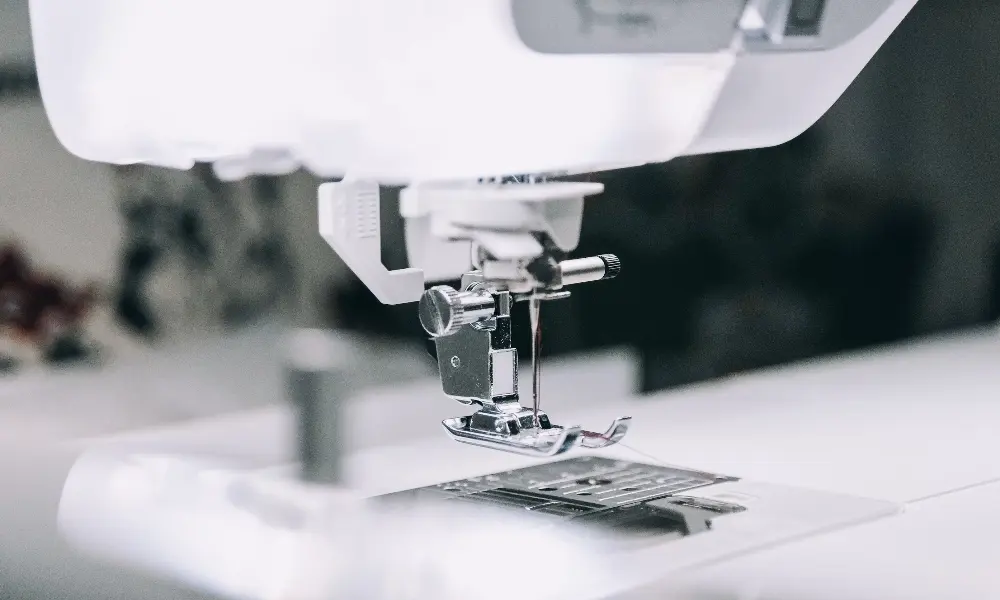
Every lockstitch operation ends with the same manual routine: stop, raise the presser foot, pull the workpiece away, and trim the needle and bobbin thread tails. An auto-thread-trimmer lockstitch machine moves that closing step into the machine. It still forms the same 301 lockstitch, but a controlled knife and wiper assembly cuts both threads close to the fabric after each seam. This article explains where the thread and time savings really come from, what to check before buying, and how to maintain the system so it keeps paying back.
What an Auto-Thread-Trimmer Lockstitch Machine Is and How It Works
An auto-thread-trimmer lockstitch machine is a single-needle machine fitted with a thread-cutting unit, normally mounted in or under the machine bed near the hook. It produces the standard lockstitch classified as stitch type 301 in ISO 4915 [1]. After the operator signals the end of the seam — usually by pressing the pedal heel back or by triggering a sensor or panel command — the machine stops the needle in a programmed position and the trimmer cuts both needle thread and bobbin thread.
The operator does not need to rethread after each cut. The upper thread remains threaded through the needle and take-up, and the thread wiper, when fitted, moves the trimmed needle-thread tail to the underside of the fabric so the next seam can start cleanly.
The sequence matters because it determines seam quality and thread retention:
- The operator finishes the seam and gives the trim command.
- The control unit commands the motor to stop with the needle in the programmed position, usually needle up or needle down depending on the material.
- A movable knife advances into the needle thread loop and bobbin thread.
- A fixed knife cuts both threads close to the fabric underside.
- The thread wiper sweeps the remaining upper thread tail under the fabric or holds it clear so the next stitch starts without a loose loop.
Because trimming is controlled by the machine rather than scissors, the tail length is repeatable. That repeatability is the core source of thread savings.
Where the Thread and Time Savings Come From
Manual trimming leaves variable tails. One operator may cut close, another may leave long ends. Automatic trimming cuts at a consistent pre-set length close behind the needle. The thread saving per shift can be calculated as:
Material saved per shift = (average manual tail length − average automatic tail length) × number of trimmed seams per shift
Use actual measured tail lengths from floor samples before relying on a supplier’s estimate. In a high-volume lockstitch line, the saving multiplies across operators and shifts. A second saving comes from bobbin thread control: a consistent trim point keeps the bobbin thread available at the proper length for the next seam instead of leaving overlong waste or exposing short ends.
There is also a quality-related saving. Long inconsistent tails can be pulled into the first stitch of the next seam, creating nests or extra bulk at the seam start. Short repeatable tails reduce the rework that consumes both thread and operator time.
The time saving is just as practical. Without a trimmer, the operator performs several motions at every seam end: stop the machine, raise the foot, remove the part, reach for scissors, trim two threads, and reposition the part. With an auto-trimmer, the operator commands the cut and can usually remove the part immediately, especially when the machine is also fitted with automatic presser foot lift.
The saving per seam may look small, but it repeats on every component. An operation with several short seams per garment — side seams, facing edges, sleeve hems, labels — captures the most benefit. The line’s bottleneck may not change from one machine, but operator effort drops and the same station can sustain a steadier pace across a shift.
The trimmer only saves time if the operator triggers it consistently and the line supports the new rhythm. <Unire le forze per promuovere il progresso e dare potere al futuro Il team tecnico di Dubai completa lo scambio tecnico e la formazione presso Nicerbt> covers a practical technical exchange and training approach for trimmer-equipped prodottoion.
Quality and Ergonomics Benefits
A properly adjusted auto-trimmer reduces the manual hand work that contributes to operator fatigue. The operator no longer reaches for scissors at every seam end, and when automatic presser foot lift is included, the hand path becomes shorter and more repeatable.
On the quality side, repeatable tail length reduces the chance of thread tails being stitched into the next seam start. The thread wiper keeps the fabric underside cleaner and helps the next seam begin without a loose loop. These gains are most visible on thin or slippery fabrics, where long manual tails can catch easily.
Selection and Configuration Checklist
Before selecting a model, confirm the configuration with the operation in mind:
- Stitch type and seam class: confirm 301 lockstitch performance according to ISO 4915 [1].
- Needle stop position: needle-up or needle-down stopping changes how the operator handles edges and corners.
- Thread wiper: required on most automated seams to keep the next seam start clean.
- Motor and drive: direct-drive servo machines support controlled needle stopping and faster trim commands. Check speed curve, acceleration, and braking.
- Presser foot lift: automatic or knee lift reduces the operator’s hand motion after trimming.
- Trim triggering: heel-back, panel button, or sensor. Match it to the operator’s foot and hand rhythm.
- Bobbin management: low-bobbin detection helps avoid interruptions in long runs.
- Electrical requirements: confirm voltage and frequency against the factory supply before ordering.
- Safety: machine guarding and stopping controls should meet ISO 10821 [2] and local regulations.
Cost Justification and Payback
An auto-trimmer model usually costs more than a standard lockstitch machine. The payback calculation should include thread saved per shift, labor time saved per shift, and the value of avoided rework. A simple comparison can be built with the formula:
Payback period = incremental machine cost / (daily thread saving + daily labor time saving + daily rework saving)
Do not use a flat “factory average” saving for every operation. A high-stitch-count, multi-seam operation will show a different result from a long-run straight seam with few stops. The most credible justification comes from measuring the operation before purchase: count seams per shift, time the manual trim motion, and weigh or estimate the thread tail waste.
Before comparing trimmer and non-trimmer machine costs line by line, look at the whole equipment and service picture. <La tua piattaforma unica per l'approvvigionamento di attrezzature per cucire> covers the one-stop procurement, spare-parts, and service logic that affects total cost of ownership.
If you are standardizing auto-trimmer lockstitch machines across a line, send the garment type, seam list, and target output to sales@tzpioneer.com or call +86-18069305333. The right trimmer configuration depends on the fabric mix and operator flow, so a machine list built around those details is more reliable than a generic package.
Maintenance and Operator Training
The trimmer is a wear point. Daily housekeeping should remove lint from the knife area, throat plate, and wiper. Check the movable and fixed knives for sharpness and adjustment according to the manufacturer’s schedule. A dull or misaligned knife cuts roughly and can leave ragged tails or fail to cut the bobbin thread cleanly.
Operator training should include the trim command, needle stop settings, proper hand position during trim, and daily checks. When the machine is fitted with automatic presser foot lift, the operator should learn the new sequence so the foot lift and trim command do not conflict.
Knife wear and lint affect trim quality just as much as the machine settings. <Meetlin Group Conducts Technical Exchange With Zhejiang Qixing Empowering Service Upgrading Of Unique Series Equipment In The Market> covers service and technical-upgrading points that keep production equipment performing in the market.
Get the right auto-thread-trimmer lockstitch configuration. Send the following details to get a focused recommendation instead of a generic quotation:
- Garment or product type and the main fabric weight.
- Seam list, stitch lengths, and daily output.
- Whether the operation is a single station or a full line.
- Preferred bed type, needle direction, presser foot lift, and trim trigger.
- Voltage, frequency, and destination country or port.
- Whether features such as bobbin detection, stitch counting, or network connectivity are required.
Contact UNIQUE at:
Email: sales@tzpioneer.com
Phone: +86-18069305333
FAQ
Do I need an auto-thread trimmer on every lockstitch machine?
No. Install auto-trimmers where repetitive trim motion consumes a meaningful share of the cycle time or where inconsistent tails create rework. Long straight seams with few stops may not need one on every station.
Does automatic thread trimming weaken the seam?
The cut happens after stitch formation, so with correct tension and tail length the program does not alter the 301 lockstitch strength [1]. The quality risk is improper wiper clearance or a dull knife, which can create ragged starts.
How much thread does an auto-trimmer save?
The saving depends on tail length difference and seam count: (manual tail length − automatic tail length) × trimmed seams per shift. Measure actual tail lengths on the floor before quoting.
What maintenance does the trimmer require?
Clean lint from the knife area daily, check knife sharpness and alignment, verify the wiper travel, and follow the manufacturer’s replacement interval for knives.
Can an existing lockstitch machine be retrofitted with an auto-trimmer?
Some direct-drive or electronically controlled models can accept trimmer kits, but the bed casting, control system, and motor must be compatible. Factory-fitted systems usually provide more repeatable operation.
Should I choose heel-back or panel-triggered trimming?
Match the trigger to the operator’s rhythm. Heel-back keeps the hands on the workpiece; panel triggering may work better when the stop position is consistent and the operator has time to touch the panel.
Riferimenti
[1] ISO 4915:1991, Textiles — Stitch types — Classification and terminology, International Organization for Standardization.
[2] ISO 10821:2005, Industrial sewing machines — Safety requirements for sewing machines, units and systems, International Organization for Standardization.
Se sei interessato, dai un’occhiata a questi articoli correlati:
Technology Empowers Fashion Nicerbt Unique Attends Hm Supplier Tech Summit Empowering Intelligent Upgrading Of Garment Supply Chain
Unique Teams May Visit To Egypt Technical Excellence And Market Confidence
Unique And Ekinci Makina Reaffirm Partnership For Iraq Market