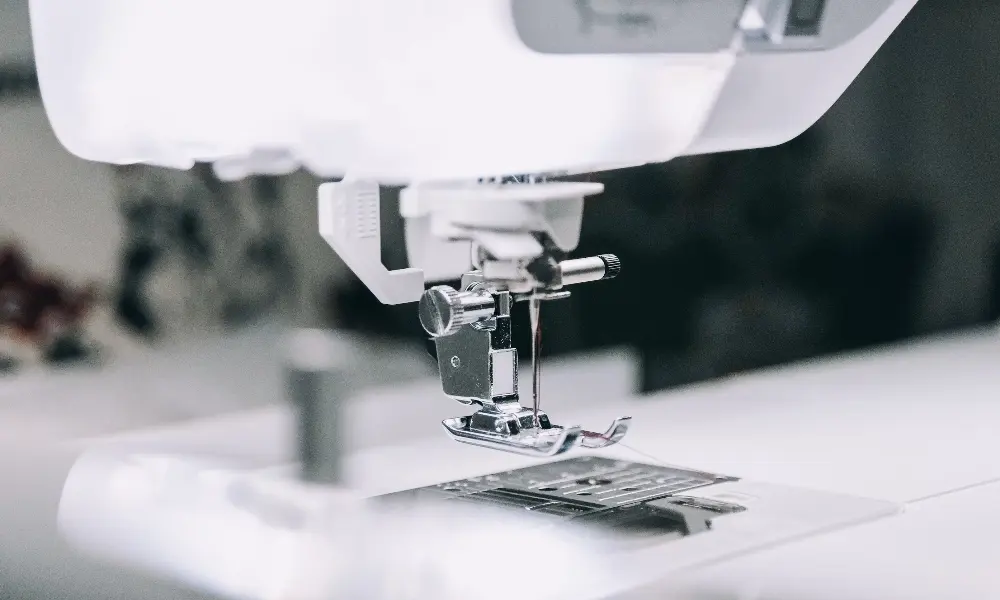
Zigzag and straight stitch are among the most frequently compared stitch types in garment manufacturing. The decision affects seam stretch, thread consumption, edge finishing and the machine specification you eventually buy. In most produition lines, the answer is not one machine over the other; it is which stitch class belongs where. This comparison looks at both from a factory-floor perspective and connects each use to the right equipment.
What Changes Between a Zigzag and a Straight Stitch
At the stitch-formation level, the two stitches are closely related. In the ISO 4915 classification, a conventional straight lockstitch is identified as class 301, while a zigzag lockstitch belongs to class 304 [1]. A straight stitch forms a single row of interlocked needle and bobbin threads with the needle moving in a straight line as the feed advances the fabric. A zigzag stitch uses the same lockstitch interlacing, but the needle alternately moves from side to side. That side movement creates the diagonal thread segments that change how the seam behaves.
The practical difference is not cosmetic. The diagonal thread path gives a zigzag seam a built-in elongation reserve: when the fabric stretches, those angled segments can straighten before the thread itself is overloaded. A straight stitch has much less of that reserve because the thread lies almost flat in the stitching direction. This is why straight stitch and zigzag stitch produce different results on woven, knit, elastic and decorative applications even when the same thread and needle size are used.
At UNIQUE, we treat this as a specification question first, not a brand or model question. Once the stitch class, width, density and fabric range are clear, machine selection becomes much simpler. The same logic also applies to the broader machinery decision.
The same comparison logic applies to wider machinery decisions. <Différences clés entre les machines à coudre, à broder et à découper> covers how machine categories differ and where each one earns its place in a garment line.
| Factor | Straight Stitch | Zigzag Stitch |
|---|---|---|
| ISO stitch class | 301 lockstitch | 304 zigzag lockstitch |
| Thread path | Straight single row | Alternating diagonal segments |
| Built-in elongation | Low | Higher because of angled thread reserve |
| Typical stable fabrics | Woven shirts, trousers, denim | Knits, rib, elastic panels, lingerie |
| Main production uses | Main seaming, topstitching, assembly | Stretch seams, edge finishing, appliqué, elastic attaching |
| Seam bulk | Lower and flatter | Slightly more raised |
| Thread consumption | Lower | Higher for comparable stitch density |
| Common industrial machine | Single needle lockstitch machine | Dedicated zigzag machine |
Stretch Behavior: Why Stitch Geometry Matters
Stretch behavior is where most factories separate the two stitch types. On a stable woven fabric, a straight lockstitch carries load along the seam without much demand for extension. The same seam on a knit or spandex-blend panel can crack when the garment is stretched because the thread has little extra length to give. A zigzag stitch reduces this problem by laying thread at an angle; the fabric can extend further before the thread reaches its limit.
That does not make zigzag the universal solution for every stretch garment. For high-volume activewear, underwear and swimwear production, factories usually assemble the main stretch seams with an surjeteuse or a chainstitch machine because those stitch classes can trim, edge and stretch in one pass. A zigzag lockstitch is then used for selected operations such as elastic attaching, lace placement, decorative panels, lingerie seams or short runs where a separate edge finish is acceptable.
For fabrics with moderate give, a narrow zigzag with moderate stitch length often provides enough elongation without creating the heavy build-up of a wide decorative zigzag. Operators should test the approved sample under the actual wearing direction of stretch, because a seam that looks good on the table may still fail when pulled across the body.
Decorative and Edge-Finishing Uses
The second major use for zigzag is decorative work. A dedicated zigzag machine lets a factory produce satin-stitch appliqué, secure lace and elastic attachments, close picot-style edges and run decorative stitch patterns on fashion panels. When the stitch length is shortened and the width increased, the zigzag forms a dense satin column. That column is also used in embroidery-style work, monograms and small emblem outlines.
For parallel decorative rows or wide elastic bands, a multi-needle machine can create several rows in one pass. When patterns need to be repeated accurately across a run, a special pattern sewing machine stores the sequence and removes some operator variation.
Zigzag also works as an edge finish on woven garments in short-run or sample production. It wraps the raw edge with a lockstitch and prevents fraying. In mass production, however, most factories use an overlock or interlock machine for edge closure because they are faster and combine edge trim and seam in one operation. Zigzag edge finishing still appears in places where a true overedge line is not available or where the edge finish is also part of the decorative design.
Where Straight Stitch Still Wins
Straight stitch remains the default for most woven garment assembly. Shirts, trousers, denim, uniforms, workwear and standard outerwear panels typically need strong, flat, low-bulk main seams. A straight lockstitch is faster to run, uses less thread for comparable stitch density and produces cleaner topstitching because the needle path is predictable.
In a woven shirt or trouser line, the main assembly and topstitching work belongs on a single needle lockstitch machine. The straight stitch class is also the basis for many specialized operations: buttonholes, bar tacks, blind hems and certain decorative topstitch effects all use lockstitch or specialized stitch classes rather than zigzag.
Even in a stretch-oriented line, straight stitch still appears. Facings, pocket flaps, labels, fly constructions and some topstitch details on stable areas can be sewn with a straight lockstitch without compromising garment function. The rule is to place straight stitch where the seam does not need to elongate with the fabric, and use a stretch-compatible stitch where it does.
Machine Requirements and Factory Selection
Straight and zigzag machines are not interchangeable on the factory floor. A dedicated zigzag machine needs a slotted needle plate or wide-opening plate to accommodate the side needle movement, while a straight lockstitch uses a standard straight-stitch plate and presser foot. The feed timing, hook timing and thread take-up must all be set for the selected width, especially when switching between straight and wide zigzag settings.
For straight main seams, a single needle lockstitch machine with the correct feed system covers most woven work. For thicker materials such as denim, vinyl or coated fabrics, a compound feed or needle feed lockstitch may be needed to avoid ply shift. For zigzag, the buyer should check the maximum zigzag width, stitch length range, needle position options and whether the machine supports three-step or programmed patterns if those operations are required.
When a line includes stretch garments, the equipment list normally combines machines. A zigzag machine supports specific elastic and decorative steps, while overlock and chainstitch machines carry the main stretch assembly. Buying the stitch classes as a coordinated set avoids the common problem of owning a zigzag machine but lacking the overlock capacity needed to finish the same garment.
When you source several stitch types at once, the questions shift from single-machine specs to line-level fit. <Votre plateforme unique d'approvisionnement en matériel de couture> covers how to plan a complete equipment package around your main garment categories.
Quality Control and Specification Details
A clear specification prevents most stitch-related quality disputes. The factory should record the stitch class from ISO 4915 [1] and the seam type from ISO 4916 [2]. ASTM D6193 provides a common inspection language for stitches and seams in garment and sewn-product quality programs [3]. Writing only “zigzag stitch” on a spec sheet is not enough; the width, stitch length, density, seam allowance and required elongation should be stated.
For straight stitch, the main quality risks are unbalanced tension, puckering, skipped stitches at high speed and needle damage. For zigzag, the common risks include skipped corner stitches, width variation, tunneling on lightweight knits and thread breaks when a dense zigzag is run at high speed with the wrong needle or thread combination.
In first-piece inspection, compare the approved sample in the correct stretch direction. For knit and elastic panels, pull the seam the way a wearer would move. If the thread cracks before the fabric reaches its normal extension, the stitch class, stitch density or thread choice should be reviewed before bulk cutting continues.
Plan Around the Stitch, Not Just the Machine
The right decision starts with the stitch requirement. Once the fabric range, expected elongation and decorative finish are known, the lockstitch or zigzag equipment can be specified correctly and the supporting machines around it can be selected as a set.
Send the UNIQUE team your fabric type, required stitch class, stitch width, stitch density and expected line output. We will recommend the matching machine combination and provide a complete quotation with spares and after-sales support.
Email: sales@tzpioneer.com
Phone/WhatsApp: +86-18069305333
Frequently Asked Questions
Is a zigzag stitch always stronger than a straight stitch on stretch fabric?
Not universally. A zigzag stitch offers more built-in elongation because of its diagonal thread path, so it usually performs better than a straight stitch on fabric that must stretch. Final strength still depends on stitch density, thread type, seam class and the direction of pull.
Does a zigzag machine replace an overlock machine?
No. In production, an overlock machine performs an overedge stitch class that trims and finishes the edge in one pass. A zigzag machine is better used for elastic attaching, lace, lingerie seams, decorative work and some edge finishing. High-volume knit and activewear lines normally need both rather than one replacing the other.
Can one industrial machine switch between straight and zigzag?
Many zigzag lockstitch machines can be set to zero zigzag width for some straight work, but they are not a productive replacement for a dedicated high-speed single needle lockstitch on long straight main seams. For efficient straight assembly, a dedicated straight machine is the usual choice.
What specifications should I check before buying a zigzag machine?
Check the maximum zigzag width, stitch length range, needle position options, presser foot lift, motor or direct-drive system, table and attachment compatibility, and availability of local after-sales support and spare parts. These details affect daily output more than the machine name alone.
Références
[1] ISO 4915:1991, Textiles — Stitch types — Classification and terminology, International Organization for Standardization, Geneva, Switzerland.
[2] ISO 4916:1991, Textiles — Seam types — Classification and terminology, International Organization for Standardization, Geneva, Switzerland.
[3] ASTM D6193-16(2020), Standard Practice for Stitches and Seams, ASTM International, West Conshohocken, PA, USA.
Si vous êtes intéressé, consultez ces articles connexes :
Unique Teams May Visit To Egypt Technical Excellence And Market Confidence
Meetlin Group Conducts Technical Exchange With Zhejiang Qixing Empowering Service Upgrading Of Unique Series Equipment In The Market
Dîner de reconnaissance des fournisseurs du Milin Group Taizhou Center Taizhou