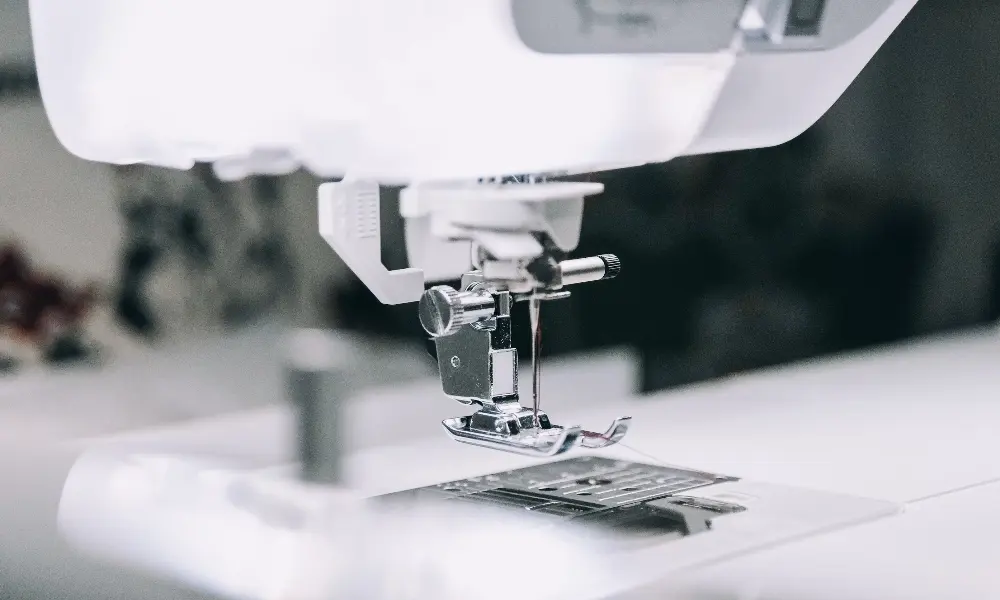
For a 3-thread or 4-thread industrial overlock machine, two dimensions decide most downstream quality problems: stitch width and needle gauge. They determine how much fabric is enclosed by the overedge stitch, how far the load-bearing needles sit from the trimmed edge, whether loops cover without curling, and which needle plate, presser foot and needle system the machine must run. ISO 4915 places overedge stitches in class 500 according to how needles and loopers interloop [1]. It does not, however, choose the correct width for your product. That is a productoion specification, and it should be written into the quotation rather than left to assumptions.
For readers still mapping the full cutting-to-finishing line, <Su plataforma integral de adquisición de equipos de costura> covers how overlock, lockstitch, cutting and finishing equipment are specified within one procurement process.
What Overlock Stitch Width Actually Controls
Stitch width on an overlock is the lateral distance from the main needle line to the trimmed fabric edge. On a single-needle 3-thread overlock, that means the distance from the needle to the cut edge. On a two-needle 4-thread machine, the second needle extends the seam line further away from the cut edge and forms the safety seam. A stitch width specification is therefore not simply “how wide the loops look.” It defines how much of the fabric edge is enclosed and how far the load-bearing stitches are from the cut edge [1].
Many common industrial overedge machines allow adjustment inside a limited window, often in the range of about 3.0–7.0 mm depending on the subclass. The exact range is fixed by the throat plate, knife position, looper travel and presser foot toe. You cannot always specify a wider plate later without replacing a matched set of parts. That is why the approved sample width must be recorded before ordering, not after the machine arrives.
The practical effect of width is easy to see during the first seam test. If the width is too narrow for a heavy knit or woven, the overedge loop sits close to the cut edge and the seam may curl, open or expose raw yarns under stress. If the width is too wide for a lightweight lining, the stitch consumes more thread, creates a bulky edge and can cause unwanted puckering. The correct width is the one that stabilizes the edge without changing the fabric hand.
Needle Gauge: Two Specifications That Sound Like One
Needle gauge can mean two different things in a purchasing conversation: the center-to-center distance between needles on a multi-needle overlock, and the needle system code stamped on the needle shank. Both belong in the specification.
Needle spacing, or gauge dimension
On 2-needle 4-thread or 3-needle 5-thread machines, gauge is the distance between adjacent needles at the needle plate. It must match the needle plate holes, the presser foot slot and, on some machines, the looper covers. Common industrial gauge options may include 2.0 mm, 2.5 mm, 3.0 mm, 4.0 mm, 4.8 mm and 5.6 mm, but only the machine builder’s parts list is authoritative. If you specify the gauge but not the matching plate set, the machine can be ordered with a dangerous mismatch.
Needle system
Needle system is the shank design that fits the needle bar and timing geometry. Industrial maquina overlocks commonly use flat-shank systems such as DC × 27; some models use B27 or other system codes. Record the system from the manual or from the existing needle packet, and specify it on every needle order. Needle system is independent of needle size. A DC × 27 needle in size 80 and size 90 shares the same shank, but a lockstitch-system needle of the same size will not seat or time correctly in an overlock.
Matching Stitch Width and Needle Gauge to Fabric and Seam Type
The seam type should be chosen first. ISO 4916 classifies seam and seam finishing types, and the decisions for stitch width and gauge follow from that choice rather than from machine availability [2]. The table below gives practical starting points, but the final values should come from an approved seam test on the actual fabric.
| Fabric group | Typical overlock use | Stitch width starting point | 2-needle gauge starting point | Needle size starting point |
|---|---|---|---|---|
| Light knit: jersey, underwear | 3-thread overcast | 3.0–4.0 mm | narrow, 2.0–2.5 mm | 70/10–80/12 ball point |
| Medium knit: rib, interlock | 4-thread safety or overlock | 4.0–4.8 mm | 2.5–3.0 mm | 80/12 ball point |
| Light woven: lining, shirting | 3-thread seam finishing | 3.5–4.0 mm | single needle or narrow | 75/11–80/12 |
| Medium woven: trousers, uniforms | 4-thread safety stitch | 4.8–5.6 mm | 3.0–4.0 mm | 90/14 |
| Heavy woven: denim, canvas | 5-thread safety or heavy 4-thread | 5.6–6.4 mm | 4.0–5.6 mm | 100/16–110/18 |
| Coated or laminated fabric | 4-thread overedge before tape sealing | 5.0–6.0 mm | 3.0–4.0 mm | 90/14 with appropriate point |
These values are not universal law. A tightly knitted performance fabric may behave differently from a loose single jersey, and a coated fabric may require a different needle point or a wider stitch to prevent the edge from cutting through the film. Keep the sample, the seam result and the measured width together so the supplier can replicate the machine setup before shipment.
The Specification Block That Prevents Wrong Quotations
A clear overlock specification does not need to be long. It needs to remove guesswork from the supplier.
- Stitch type: state the ISO 4915 class 500 stitch and the thread count, such as 3-thread overedge, 4-thread mock safety or 5-thread safety stitch [1].
- Stitch width: give the approved measured width from the seam sample, plus the acceptable adjustment window.
- Needle gauge: state “single needle” or give the exact center-to-center distance for multi-needle machines.
- Needle system and size: record the system code and the primary needle size for the main fabric.
- Conversion parts: list the needle plate, presser foot, looper guard or knife set required for the chosen gauge.
- Differential feed: specify whether the machine needs adjustable differential feed and the expected ratio range.
- Output requirements: include maximum speed, motor voltage and frequency, and any pneumatic or suction requirement.
ASTM D6193 offers equivalent stitch and seam terminology in a quality assurance context, which can help align the buyer’s seam description with the supplier’s technical documents [3]. Using the standard terms plus the measured dimensions avoids the common situation where a buyer asks for a “standard 4-thread overlock” and the supplier must still guess the gauge, plate and stitch width.
Common Overlock Specification Mistakes
- Specifying only “4-thread overlock.” That confirms the machine family but not the stitch width, needle gauge, needle system or plate set.
- Equating stitch width with seam allowance. The overedge stitch sits inside the seam allowance. A 10 mm seam allowance may carry a 4.0 mm overedge.
- Ordering needles by size only. Size describes blade diameter; system describes shank geometry. Both are separate specification items.
- Assuming needle gauge is changed with a dial. On many machines, stitch width is adjustable while needle spacing is fixed by the plate and foot set. Changing spacing often requires conversion parts.
- Running one width and gauge on every fabric. Light lining, heavy denim and stretch activewear place different demands on edge coverage, loop length and needle spacing.
- Ignoring the loopers. Stitch width and gauge affect looper travel, spreader timing and thread consumption. A width change can disturb loop formation if the looper settings and plate do not match.
For a machine-level comparison that prevents buying the wrong production threshold, <Diferencias clave entre las máquinas cortadoras de bordado y costura> covers how cutting and stitching technologies differ across garment equipment categories.
Get Your Overlock Specification Checked Before You Buy
Specifying stitch width and needle gauge before ordering avoids later problems with plate conversions, needle systems and spare-part availability. Send your fabric type, seam finish, approved stitch width or physical sample, and current machine model, and our technical team at UNIQUE will return a written recommendation covering machine subclass, needle gauge, needle system, plate set and after-sales spare parts. Contact sales@tzpioneer.com or call/WhatsApp +86-18069305333.
FAQ
Is overlock stitch width the same as the seam allowance?
No. Stitch width is the span of the overedge stitch from the needle line to the trimmed fabric edge. Seam allowance is the distance from the seam stitch line to the cut edge. A wide seam allowance can still use a narrow overedge stitch, and the two dimensions should be specified separately [1][2].
What needle gauge should I specify for a 4-thread overlock?
Start from the approved stitch width and the fabric weight. For medium woven safety stitching, many factories begin testing with a 3.0–4.0 mm gauge. Light knits usually need a narrower gauge, while heavy woven work may test wider. The exact choice must match the machine’s needle plate and presser foot set.
Can I change stitch width without changing needle gauge?
Yes, within the machine’s adjustable width range. Changing stitch width does not necessarily change the distance between needles if the gauge is fixed. If you need a wider edge than the plate and knife allow, or a different needle spacing, you will need a conversion kit and possibly a different needle plate.
Why does the same needle size come in different systems?
Needle size refers to blade diameter, while needle system refers to shank shape, length and fitting geometry. An overlock machine requires a specific system to seat the needle correctly and maintain hook and looper timing. Ordering only by size can produce needles that are dimensionally correct but mechanically incompatible.
What should a machine quotation include for specification control?
The quotation should state stitch class, thread count, stitch width range and approved sample dimension, needle gauge or single-needle status, needle system and size, differential feed requirements, plate/feet/knife part numbers, maximum speed, motor specification and any compliance documentation requested by the buyer [3].
Referencias
[1] ISO 4915, Textiles — Stitch types — Classification and terminology.
[2] ISO 4916, Textiles — Seam types — Classification and terminology.
[3] ASTM D6193, Standard Practice for Stitches and Seams.
Si está interesado, consulte estos artículos relacionados:
Live From Cairo Unique Shines At Egy Stitch Tex 2025
Unique Strength Debut At Jiam 2024
Carrera contra el tiempo: viaja a 8 países europeos en 20 días
Unveiling Ceremony Of Milin Group Taizhou Center