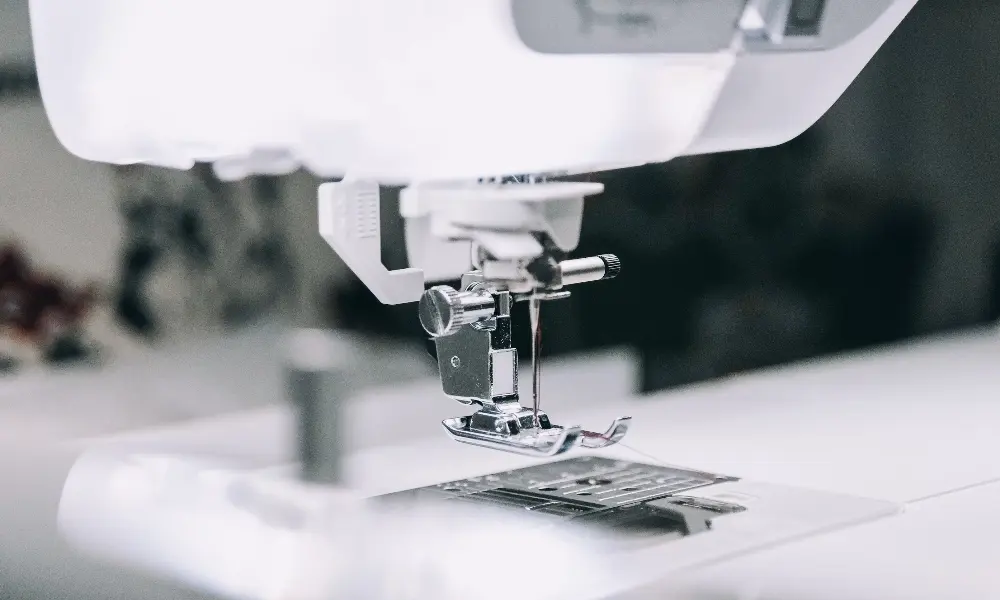
A cylinder bed multi-needle machine solves a specific production problem: forming clean, parallel stitch rows around a tubular, circular, or ring-shaped workpiece without flattening or twisting the fabric. On a flatbed, a closed tube — a rib cuff, a sleeve band, a knit bottom collar — must be folded open and repositioned repeatedly. On a cylinder bed, the narrow cylindrical platform lets the operator rotate the tube smoothly around the bed while the needle head holds its line. That single difference is what makes circular operations faster, straighter, and far more repeatable.
This guide covers the bed design, the stitch classes most often specified for circular sewing operations, the gauge and feed decisions that matter at purchase time, and the operating and maintenance habits that protect stretch-seam quality in daily production. Use it to lock the specification before purchasing; the final section gives the exact detail list to include in an inquiry.
What a Cylinder Bed Multi-Needle Machine Does Differently
Three design elements separate this machine class from the rest of a sewing floor.
The cylinder bed. The work surface is a narrow cylindrical arm under the needle, with the hook, looper, and feed mechanism contained inside the cylinder. A tubular workpiece slides over the cylinder like a sleeve over an arm, so the operator can feed a full 360° ring continuously without opening the seam. This matters most when the workpiece is a closed band — cuff, waistband, neckline binding, sock rib, or circular hem. For single-needle topstitching or small-radius assembly on a similar platform, a cylinder bed lockstitch sewing machine uses the same bed principle with a lockstitch formation.
Bed type is only one decision in a complete machine room. <Key Differences Between Sewing Embroidery Cutting Machines> covers how machine configuration changes across sewing, embroidery, and cutting workflows.
The multi-needle head. Two, three, or four needles descend in parallel and form as many stitch rows in a single pass. This is why multi-needle units outperform repeated single-needle passes on bands and decorative parallel topstitching — the row spacing is fixed by the needle gauge, not by operator skill. Within the broader multi needle machine category, cylinder bed variants are the subset designed specifically for tubular access.
The chainstitch or coverstitch formation. Most cylinder bed multi-needle heads form class 400 multi-thread chainstitches or class 600 covering chainstitches rather than lockstitch. The interlooped thread structure elongates with stretch knits, so the seam moves with the fabric instead of cracking when a cuff gusset is pulled over a hand or a waistband is stretched during wear. The wider chainstitch machine family includes cylinder bed, flatbed, and feed-off-the-arm forms.
Circular Sewing Applications and Stitch Choices
Circular operations share a common requirement: the workpiece is either a knitted tube or a flat panel that has just been sewn into a ring, and the next operation must preserve that ring without distortion. Five jobs dominate factory demand:
| Operation | Typical stitch class (ISO 4915) | Typical needle count | Primary fit / finish concern |
|---|---|---|---|
| Rib cuff or sleeve band attachment | 400-class chainstitch or 406 coverstitch | 2–3 | Stretch recovery at the seam |
| Bottom band hem on knit shirts | 406 bottom coverstitch | 2 | Flat, low-bulk interior |
| Waistband elastic on underwear / activewear | 400-class chainstitch or 406 | 3 | Elastic feed without waving |
| Neck binding / collarette seaming | 406 or 602 covering stitch | 2–4 | Even binding width around the curve |
| Tubular sleeve or leg hemming | 605 / 607 covering chainstitch | 3–4 | Top-cover appearance and edge coverage |
| Sock and small-diameter circular seams | cylinder overedge or chainstitch | 2–3 | Minimum tube clearance |
Under ISO 4915, the 406 and 407 formations are part of stitch class 400, the multi-thread chainstitches, while 602, 605, and 607 belong to class 600, the covering chainstitches [1]. Seam terminology for hemmed, bound, and joined edges follows the classifications in ISO 4916 [2]. In practice, the stitch choice is driven by two questions: whether the seam must be low-bulk on the inside, favoring a bottom-cover-only 406, or fully covered on the exposed face, favoring 605 or 607, and how many parallel rows the design requires.
A note on needle count versus gauge: adding a third or fourth needle widens the finished stitch and increases thread consumption. It does not by itself improve strength. For a given rib band, the correct choice is usually the narrowest gauge and lowest needle count that still achieves the required topstitch width and edge security.
Key Specifications: Gauge, Bed Size, Stitch Class, and Feed
When you sit down to request a quote, these five specifications decide whether the delivered machine fits the actual operation.
Needle gauge. Gauge is the center-to-center distance between adjacent needles. For cuffs, bottom bands, and neck bindings, common gauges include 1/4 in (6.4 mm), 5/16 in (7.9 mm), and 3/8 in (9.5 mm); decorative multi-row work may go wider or narrower. The gauge must match both the design topstitch width and the band tape or elastic width — this is a specification to fix from the sample, not to leave open.
Needle count. Two, three, or four needles. Select by the number of parallel rows the seam print requires. More needles also means more looper threads to balance, so a four-needle head is not automatically better — it is simply a different stitch width and thread budget.
Cylinder bed diameter and tube clearance. The bed must fit inside the smallest closed band the line will sew. If the band inside diameter is smaller than the cylinder, the operator cannot rotate the workpiece freely; if the bed is too small for a heavy band, the band slops and loses feed control. Specify the minimum finished band inside diameter and the thickest elastic or rib combination.
Stitch class. Confirm whether the seam needs a class 400 chainstitch or a class 600 coverstitch edge formation under ISO 4915 [1]. Three-needle 605 top-and-bottom cover is common on exposed outer hems, while 406 bottom cover is common on low-bulk interior hems.
Differential feed. On circular knit bands, differential feed is the difference between the front and rear feed rates. Set correctly, it keeps the band from waving or over-stretching as it rotates over the cylinder; set incorrectly, it turns a smooth ring into a lettuce edge. When specifying, record the differential ratio range the machine offers for the fabric class.
Speed is the last number on the sheet, not the first. Manufacturer-rated speeds for industrial cylinder bed multi-needle heads commonly sit in the 3,000–4,500 SPM range, but the sustainable speed on a stretch band is set by looper timing, needle deflection, and crossing-seam control — not by the nameplate maximum.
For stitch and seam selection on knit constructions, ASTM D6193-16 offers a practical reference for matching stitch type and stitch density to the fabric and end use [3].
| RFQ parameter | Example entry |
|---|---|
| Needle gauge | 3/8 in (9.5 mm) |
| Needle count | 3 |
| Minimum band ID | 110 mm |
| Stitch class | 605 |
| Rated speed | 4,000 SPM |
| Differential feed | machine-dependent range |
Need a model-matched recommendation? Send the minimum band inside diameter, fabric type and GSM, required stitch class (for example, 406 or 605), needle count, and gauge to sales@tzpioneer.com with the subject line “Cylinder bed multi-needle — [your application]”. A technical specialist will confirm compatible bed profiles, gauge availability, and production lead time.
Setup and Operation for Consistent Tubular Seams
Most quality complaints on circular multi-needle work trace to four causes that show up as skipped stitches, thread breakage, or wavy bands.
Looper and needle timing. In a chainstitch or coverstitch head, each needle must land in the looper take-up window in sequence. As needles wear or deflect at crossing seams, the pick-up fails and a skip shows up a few stitches later. Set and check timing at the recommended stitch length, not at an arbitrary test length.
Thread pairing. Stretch circular seams hold best with threads that can elongate with the fabric. Polyester corespun or textured polyester/nylon combinations are common because they combine strength with stretch recovery. Keep the needle threads and looper threads matched in type and size; mixing a rigid needle thread over a stretchy looper thread produces unbalanced loops.
Differential feed and operator rhythm. The feed must carry the band at the same effective rate the operator rotates the tube. A smooth, continuous rotation with light support — not pulling — preserves the ring shape. At side seams and band joins, slow the machine briefly and let the feed clear the bulk rather than forcing the needle through a thickened crossing.
Thread tension per row. On a multi-needle head, balance each needle row individually before balancing the loopers. A tight outer row can curl the seam to one side even when the machine test stitch looks acceptable.
For flat, off-the-arm double-turned hems — a different bed family from tubular cylinder work — feed of the arm machine platforms handle cuff and hem folding on open panels.
Care and Maintenance That Protect Seam Quality
Cylinder bed multi-needle heads live or die by looper area cleanliness and bed finish.
Lint control. Chainstitch and coverstitch formations release lint, and the cylinder bed funnels it toward the looper and feed area. Clear lint from the looper, feed dogs, and thread paths on a set schedule — daily on high-volume knit lines — because lint changes effective tension and can create the intermittent skips that take hours to trace.
Lubrication. Follow the manual for oil grade and interval. Automatic lubrication systems reduce but do not eliminate inspection; check that oil reaches the looper mechanism without being thrown onto the fabric.
Bed surface condition. The cylinder bed is a fabric-contact surface. Any burr, scratch, or wear ridge drags the tube as it rotates and causes the wavy-edge defect that operators misdiagnose as a tension problem. Inspect the bed finish during maintenance and dress or replace worn surfaces before they damage fabric.
Needle replacement discipline. Replace needles on schedule, not on failure. A dull or bent needle stresses looper timing and creates the slight fabric deflection at crossing seams that quality auditors catch. On high-stretch synthetics, use fresh ball-point needles matched to the fabric weight.
Safety and guarding. Multi-needle heads concentrate several needle points and loopers in a small area, so guarding and operator protection should follow the safety requirements for industrial máquina de cosers in ISO 10821, including needle guards, eye protection where required, and lockout before cleaning or timing work [4].
If a single purchase spans several machine classes — multi-needle, lockstitch, cutting, and finishing — <Your One Stop Sewing Equipment Procurement Platform> covers how full-range sourcing changes service consistency and shipping coordination.
Request a Specification-Matched Quote
To quote a cylinder bed multi-needle machine accurately, the following details are needed. A complete specification shortens the back-and-forth from days to a single reply.
- Minimum finished band inside diameter
- Fabric type, weight, and stretch direction
- Required stitch class (for example, 406, 605, or 607)
- Number of needle rows and gauge
- Elastic, rib, or binding width and thickness
- Target output per shift or required SPM
Send the details to sales@tzpioneer.com or call/WhatsApp +86-18069305333. If you have a reference sample or a clear photo of the band, attach it — the bed profile and gauge can usually be confirmed directly from the sample.
FAQ
When does a cylinder bed beat a flatbed for circular sewing?
When the workpiece is a closed tube or small ring that must rotate 360° during sewing. A flatbed forces the operator to flatten the tube and reposition it repeatedly, which creates drag, twist, and inconsistent row spacing. A cylinder bed lets the tube sit over the cylindrical platform and rotate continuously, so the needle rows stay parallel around the full circumference.
What needle gauge should I choose for rib cuffs and bottom bands?
1/4 in (6.4 mm) and 5/16 in (7.9 mm) are common for lightweight cuffs and neck bindings, while 3/8 in (9.5 mm) is frequent on heavier bottom bands and wider topstitch. The right gauge matches the topstitch design and the band width. Confirm against a physical sample because gauge is a head specification rather than a field adjustment on most machines.
Can one cylinder bed head run multiple tube diameters?
Yes, within the clearance limit. The bed must be small enough to enter the smallest band ID and large enough to support the largest band without excess play. When the line covers a wide diameter range, specify the smallest and largest IDs and confirm both rotate freely on the same cylinder; very small diameters may require a dedicated small-diameter bed.
Which stitch class holds best on high-stretch activewear: 406 or 605?
Both stretch, but they serve different seams. 406 forms a bottom-cover stitch, leaving a low-bulk interior — a common choice for interior hems and waistband attachment. 605 adds a top cover over the needle rows, so it is often selected when the exposed face needs full coverage and a flatter decorative finish. The decision is seam design and appearance under ISO 4915 class definitions [1], not raw strength.
What speed should I realistically run on tubular knits?
Run the machine at the speed that stays stable through band joins and side-seam crossings. Factory settings often sit below the rated maximum — many lines hold around 70–80% of rated speed on stretch circular work, with the exact number set by looper timing, needle condition, and band bulk. Sustained stitch quality beats a higher rated speed that produces skips.
How do I stop skipped stitches at side-seam crossings?
Slow briefly at the crossing, use fresh ball-point needles matched to the knit, confirm looper timing at the working stitch length, and check differential feed so the band is carried — not pulled — over the crossing. If skips persist, check for needle deflection on the thickest point of the seam and for burr damage on the cylinder bed or needle plate.
References
[1] ISO 4915:1991, Textiles — Stitch types — Classification and terminology, International Organization for Standardization, Geneva.
[2] ISO 4916:1991, Textiles — Seam types — Classification and terminology, International Organization for Standardization, Geneva.
[3] ASTM D6193-16, Standard Practice for Stitches and Seams, ASTM International, West Conshohocken, PA, 2016.
[4] ISO 10821:2005/Amd 1:2009, Industrial sewing machines — Safety requirements for sewing machines, units and systems, International Organization for Standardization, Geneva.
If you’re interested, check out these related articles:
Unique Debuts At Gtb Expo Empowering Bangladeshs Garment Industry Upgrade With Customized Automated Solutions
Unique Teams May Visit To Egypt Technical Excellence And Market Confidence
Live From Cairo Unique Shines At Egy Stitch Tex 2025
Race Against Time Travel To 8 European Countries In 20 Days