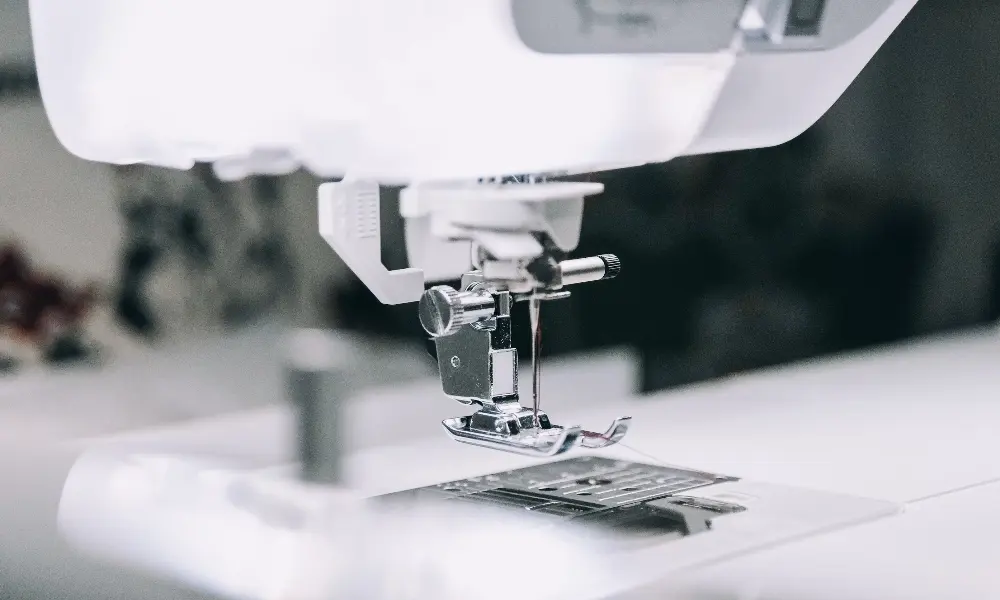
Button stitch count is not a cosmetic detail. On heavy garments—denim jackets, workwear, canvas coveralls, insulated coats, and safety apparel—the number of thread passes, the stitch pattern, and the reinforcement around the button determine whether the button survives washing, abrasion, and repeated strain. A button that tears off a heavy garment is usually a specification problem, not an operator problem.
This guide explains how to set button stitch count and reinforcement for heavy garments, what to specify on the machine, and how to inspect the result before bulk منتجأيون.
Button Stitch Count as a Strength Parameter
Industrial button attaching uses a lockstitch formation. The needle thread and bobbin thread interlock within the button holes and the fabric stack. ISO 4915 classifies this as stitch type 301, the same lockstitch construction used in general seaming, but the button stitch is applied in a very short, concentrated area [1]. The seam classification system in ISO 4916 covers how material plies are joined, while ASTM D6193 provides standard practice for describing stitches and seams in production specifications [2][3].
Stitch count matters because each thread pass adds a separate load path. A button attached with six thread passes distributes stress across six points of thread coverage. A button attached with twenty well-set passes distributes the same pulling force across a much larger total thread area. On heavy garments, the button rarely breaks first; the thread cuts, the fabric tears, or the shank collapses. Higher stitch count, when matched with the correct thread and tension, reduces all three risks.
It is important to distinguish button stitch count from stitch density. Stitch density, normally expressed in stitches per inch or centimeter, applies to seaming. Button stitch count is the total number of thread passes or needle penetrations in the button. Factories should write both values in the quality manual so the mechanic and the inspector check the same parameter.
How Many Stitches? Pattern, Count, and Load Distribution
There is no single international standard that fixes a universal button stitch count for every heavy garment. The count must be set from the fabric stack, button diameter, hole layout, wash process, and end-use stress. What ISO 4915 and ASTM D6193 do is standardize the stitch type and the way the مرفق is described, so the specification can be reproduced [1][3].
A practical specification should consider these factors:
| Factor | Effect on stitch count and reinforcement |
|---|---|
| Button diameter | Larger buttons span more fabric and need more passes to hold the wider load area. |
| Hole layout | A 4-hole button distributes load better than a 2-hole button and allows cross-pattern stitching. |
| Fabric stack thickness | Thicker stacks require more thread coverage and often a raised shank. |
| Garment stress point | High-tension points such as pocket flaps, cuffs, and front plackets need extra passes or an anchor tack. |
| Wash and finish process | Stone washing, enzyme washing, and industrial laundering accelerate thread wear and require more initial coverage. |
| Button material and edge condition | Hard or sharp button holes can cut thread faster; reinforced stitching compensates. |
For a 17–20 mm 4-hole button on heavy denim or canvas, many lines start with 16–24 total thread passes and then increase in 6–8 pass increments after pull testing. That range is a production reference point, not a legal limit. The correct count is the one that passes the factory’s button retention test without thread cutting, fabric distortion, or operator overload.
Common patterns are cross or X-tack, parallel tack, and Z-tack. A cross tack provides balanced load distribution. A parallel tack gives a cleaner appearance and works well on shank buttons. A Z-tack combines diagonal and straight coverage and is often used on high-stress plackets. The pattern must be repeatable by the machine, not left to manual variation.
A 4-hole button can be stitched with two diagonal lines, two horizontal lines, or a combination. The stronger choice for heavy garments is usually the cross pattern because stress from any direction is carried by at least one diagonal thread path. If the button must sit away from the fabric, the operator adds a wrap or shank after the main stitching.
Reinforcement Beyond the Button: Anchors, Shanks, and Bar Tacks
Extra stitch count alone is not enough. Heavy garments also need reinforcement at the button attachment boundary and, where required, a separate bar tack at the stress point.
A button shank is the thread or plastic column between the button and fabric. On a flat button sewn directly to the fabric, the thread passes are exposed to abrasion and cutting. A wrapped thread shank lifts the button slightly, protects the thread from the garment surface, and gives the button room to move without stressing the fabric around the holes. For heavy outwear and workwear, a thread shank of 2–4 wraps is common, but the height must suit the fabric stack.
Anchor stitching secures the thread tail or adds a small group of locked stitches at the edge of the attachment. This prevents unraveling when one thread path breaks. On electronic آلة ربط الأزرارs, the anchor is often programmable as a start and end backtack. On mechanical machines, the operator may need to set a separate lock or tie-off.
A bar tack is a dense zigzag reinforcement used at points of concentrated strain. On heavy garments, a bar tack may be applied near the button, at pocket corners, or at the end of a placket. A dedicated آلة معالجة الشريط produces this reinforcement faster and more consistently than manual back-tacking. The bar tack should be specified as a separate operation, with its own length, width, and stitch count, rather than improvised on a general lockstitch machine.
For heavy garment lines, the most practical reinforcement package is:
- Cross or Z button tack on a programmable button attaching machine
- Wrapped thread shank on flat buttons
- Programmed anchor stitches at start and end
- Separate bar tacks at high-stress corners and placket ends
- Reinforced fabric or interlining under the button area when the shell fabric is weak
This combination prevents the most common failure mode: the button remains closed but the fabric or thread around it gives way.
Thread, Needle, and Tension Settings for Heavy Garments
Button stitch count only matters if the thread and needle can withstand the load. On heavy garments, thread choice is as important as stitch count.
Bonded nylon and bonded polyester are the standard choices. Bonded nylon offers high strength and good abrasion resistance. Bonded polyester maintains strength better in wet conditions and resists UV degradation. Cotton-wrapped polyester corespun thread is used where a softer appearance is required, but for heavy industrial garments, a strong synthetic or corespun thread is usually preferred.
Thread size should be matched to the button and fabric. A heavier thread such as Tex 60–90 is common for heavy denim and canvas buttons, while lighter fabrics may use Tex 40–50. The exact thread ticket depends on the machine and the button hole clearance. If the thread is too heavy for the button hole, the needle can damage the button edge or cause skipped stitches.
Needle size follows the fabric stack. Heavy garments typically use DB×1 system needles from size 110/18 to 140/22, depending on the number of layers and the presence of interlining. A bent or dull needle will create inconsistent stitch formation and weaken the thread. Replace needles on a fixed schedule rather than waiting for visible damage.
Tension must be balanced, not simply tight. Over-tight needle tension buries the lockstitch too deeply and can cut the thread under load. Under-tight tension leaves loose loops that snag and abrade. The correct button tack lies flat on both sides, with the interlacing pulled into the fabric but not distorting it. Button stitches should be set with the same controlled tension used for critical seams.
Laboratory seam strength testing is not normally performed on every button, but the test method for sewn seams in woven fabrics, ASTM D1683, provides a useful model for comparing attachment strength when developing specifications [4]. A button retention pull test can be performed with a force gauge, recording the load at first thread break or fabric tear. That result, not the operator’s visual check, confirms whether the stitch count is adequate.
Machine Selection for Automated Button Attaching and Reinforcing
Heavy garments require a button attaching machine that can repeat the selected pattern and stitch count across thousands of cycles. The main choice is between mechanical, cam-controlled, and electronic button machines.
A mechanical button attaching machine is simple and durable but pattern changes require cam or mechanical adjustment. This is suitable for stable, high-volume styles with one button specification. An electronic button attaching machine stores stitch count, pattern, and anchor settings in memory. That is more efficient when a line switches among different button sizes and heavy fabric stacks.
For heavy garments, look for a button attaching machine with a strong frame, positive feed, and adjustable cخروف pressure. The clamp must hold thick fabric stacks without slipping. A needle guard or button clamp alignment system prevents needle contact with the button edge. Automatic thread trimming saves time and prevents long thread tails from becoming snags in stone washing or industrial laundering.
Many factories combine the button attaching operation with a button holing machine. The buttonhole must be sized and reinforced to match the button diameter and fabric thickness. A poorly cut or loosely stitched buttonhole will fail before the button attachment. When specifying heavy garment production, do not separate buttonhole quality from button stitch count.
For high-stress reinforcing, a special bar tacking machine is the practical companion to the button attaching machine. It places dense bar tacks at pocket edges, placket ends, belt loops, and stress corners. The bar tack machine can be set to a fixed stitch count and width, so the reinforcement is identical across the run. This is far more consistent than guiding the garment under a standard آلة الغرز المتشابكة with manual back-tacking.
Heavy-garment button work is rarely a one-machine decision: the same line usually needs buttonholing, button attaching, bar tacking, and multi-needle reinforcement stations. <منصة واحدة لشراء معدات الخياطة> covers how a full-range sewing equipment supplier coordinates multi-machine sourcing and after-sales support.
Before standardizing heavy-garment reinforcement, many factories compare how different machine categories fit the full cutting-to-sewing flow. <الاختلافات الرئيسية بين آلات قطع الخياطة والتطريز> covers selection logic across sewing, embroidery, and cutting equipment.
Need a button attaching and bar tacking configuration for heavy denim or workwear? Send your fabric stack, button diameter, required stitch count, and wash process to sales@tzpioneer.com or call +86-18069305333. Our export team can recommend a matched machine set with the correct tack pattern, needle system, and thread specification.
Inspection and Failure Diagnosis for Button Stitches
Button stitch count must be checked during first-piece approval and at regular intervals, not only after a customer complaint.
Inspection points should include:
- Total stitch count against the approved sample
- Pattern orientation on the button face
- Thread balance on both sides
- Anchor stitches at start and end
- Shank height and wrap count
- Button hole alignment and tension
- Fabric damage, needle cuts, or thread abrasion around the button
A simple pull test can be done with a force gauge. Pull the button gently away from the fabric and hold for several seconds. Note the load and the failure mode. If the thread breaks at low load, increase stitch count or change to a stronger thread. If the fabric tears around the button, add interlining or adjust the shank. If the button hole cracks, check button material and clamp alignment.
Common failures on heavy garments:
- Thread shank too short: the button sits too tightly and cuts fabric during washing.
- Thread shank too long: the button moves excessively and torque damages the thread.
- Unbalanced lockstitch: one side shows loops, causing rapid abrasion.
- Skipped anchor stitches: thread tails unravel after a few pulls.
- No bar tack at stress points: high-stress areas fail even when the button itself is secure.
The best quality systems tie every button specification to a physical approved sample. The sample should show the stitch count, pattern, thread type, stitch balance, and reinforcement points. A new operator or mechanic should be able to reproduce the sample without guessing.
Get a Button Stitch Equipment Recommendation
Button reinforcing is easier to standardize when the machine, thread, and reinforcement plan are specified together. Taizhou Unique Machine Technology Co., Ltd. supports heavy garment lines with button attaching machines, button holing machines, bar tacking machines, and related industrial sewing equipment.
Contact William at sales@tzpioneer.com or +86-18069305333 with your garment type, fabric stack, button diameter, and required stitch count. We will recommend a practical machine configuration and the stitch settings to match your production volume and quality standard.
الأسئلة المتداولة
How many stitches should a 4-hole button have on heavy denim?
A common production reference is 16–24 total thread passes for a 17–20 mm 4-hole button, but the correct number depends on fabric thickness, button material, wash process, and pull-test results. Increase stitch count in small increments until the button passes the factory’s retention test without thread cutting or fabric distortion.
Does stitch count really improve button retention?
Yes. Each additional thread pass adds one more load path. A higher stitch count distributes pulling force over more thread area and reduces the chance that a single pass will cut through the fabric or break under strain. The benefit only appears if thread, needle, and tension are correct.
What thread type and size work best for heavy garment buttons?
Bonded nylon or bonded polyester in Tex 60–90 is common for heavy denim, canvas, and workwear. The thread must fit through the button holes without jamming or damaging the button edge. Corespun thread is also used where seam appearance matters, but heavy industrial garments usually benefit from a strong synthetic thread.
Can I use a standard button attaching machine for heavy coats?
A standard machine can often handle heavy coats if it has a strong clamp, correct needle size, and a programmable stitch count. For very thick or multi-layer stacks, choose a machine designed for heavy materials and add a wrapped shank plus bar tacks at stress points.
What is the difference between a button tack and a bar tack?
A button tack attaches the button with repeated thread passes, often in a cross or parallel pattern. A bar tack is a separate dense zigzag reinforcement used at stress points such as pocket corners, placket ends, or near the button. The bar tack machine produces that dense reinforcement consistently.
How do I check button stitch quality consistently?
Use an approved physical sample as the reference. Check total stitch count, pattern, thread balance, anchor stitches, shank height, and fabric damage. Perform a pull test with a force gauge and record the load and failure mode. Repeat the check at first-piece approval and at regular production intervals.
مراجع
[1] ISO 4915:1991, المنسوجات – أنواع الغرز – التصنيف والمصطلحاتالمنظمة الدولية للتقييس، جنيف، 1991.
[2] ISO 4916:1991, المنسوجات – أنواع التماس – التصنيف والمصطلحاتالمنظمة الدولية للتقييس، جنيف، 1991.
[3] ASTM D6193-16(2020), الممارسة القياسية للغرز والدرزات, ASTM International, West Conshohocken, PA, 2020.
[4] ASTM D1683/D1683M-17(2018), Standard Test Method for Failure in Sewn Seams of Woven Fabrics, ASTM International, West Conshohocken, PA, 2018.
إذا كنت مهتمًا، فراجع هذه المقالات ذات الصلة:
عشاء تقدير الموردين لمجموعة ميلين تايتشو مركز تايتشو
تألق فريد في Itcpe Vietnam Texprint 2025 يجذب الحشود وأضواء الإعلام
شركة Unique وEkinci Makina تؤكدان شراكتهما للسوق العراقية
قام الفريق الفريد بزيارة أسواق جنوب شرق آسيا وجنوب آسيا
تمكين هانوي وتشكيل المستقبل تستضيف Meetlin بنجاح قمة صناعة الملابس الفيتنامية 4 0